Thursday, June 27, 2013

Helpful Java Libraries: Notes from my IndyJUG presentation

Introduction

Yesterday, I gave a presentation at the meeting of the Indianapolis Java Users' Group. The presentation, "Serious Game Development in Java," gave some background about how I transitioned from game hobbyist to serious game development researcher, and I talked about my two successful Java-based serious games: Morgan's Raid and Equations Squared.

A portion of the attendees at the IndyJUG meeting
Usually when I talk about these projects, I am describing the immersive learning environment, my experience working with multidisciplinary undergraduate teams, or design and evaluation processes. Given that this crowd was primarily professional Java programmers, I decided to take a different tack, and I talked about the software architecture and what I learned by building these games. In particular, I talked about some of the libraries we incorporated into the game. Several attendees asked me if I could share more information about the libraries and why I chose them, so I decided to write this follow-up.

Morgan's Raid

Morgan's Raid was written using Slick2D, which had been my go-to library for Java game development. However, the original developer and maintainer, Kevin Glass, has moved on from the project, and it seems to be struggling now. Kevin did a good job keeping the libraries in sync with the native libraries of lwjgl, and with him off the project, I would not recommend starting new projects in Slick2D. Kevin has moved on to libGDX, which looks like an interesting project, although I prefer PlayN, as described in the next section.

Here is a brief description of the other libraries we used in Morgan's Raid. For brevity, I'm not including their transitive dependencies, but note that managing transitive dependencies on this project is precisely why I was blown away by Maven, as described in the next section.
  • Apache Commons CLI: robust handling of command-line arguments, which we used to easily modify runtime behavior, e.g. fullscreen vs. windowed mode
  • Apache Commons Configuration: robust handling of application configuration, such as animation speed, default volume, etc.
  • EasyMock: mocking library for test-driven development
  • Guava: broad and robust library that simplifies Java development, making particular use of the Lists, Maps, and Objects classes.
  • Joda-Time: all the time calculations are handled with this fantastic library, and if you're doing any time-based logic, you should be using it too.
  • SnakeYAML: parser for YAML, which we used to describe the cinematic scenes in the game
  • CruiseControl: though not a library, we used this for continuous integration
I have several posts on this blog about the design and development of Morgan's Raid. If you're new, here are some of the most descriptive:
When I began work on this project, I knew I wanted to develop an HTML5+Javascript solution with the least possible amount of pain. I evaluated several possibilities and settled on PlayN. This amazing library allows cross-compilation of the same codebase to desktop Java, HTML5+Javascript (via GWT), Android, and iOS (and Flash, kind of, but its support has not been great).

PlayN relies upon Maven to manage dependencies and project configuration. It took me some time to make sense out of how it was working, but now it's hard to imagine going back to manual dependency management. In Morgan's Raid, for example, when I wanted to add a new library, I had to manually download the binaries, and all the binaries of its transitive dependencies, put them into my project's lib folder, configure the build path, configure native libraries if necessary, and then hope that all the different libraries would work together. To upgrade any library to a new release, which happened to some of our core libraries during development, I had to repeat this process by hand. By contrast, to add, say, Mockito to Equations Squared, I just added this to my pom file:

<dependency>
  <groupId>org.mockito</groupId>
  <artifactId>mockito-all</artifactId>
  <version>1.9.0</version>
  <scope>test</scope>
</dependency>

That last bit, the scope, is really fascinating: it says that the project should use Mockito only when running unit tests. Scopes aren't needed for most of the libraries I use, but this example shows how simple a process it is to specify them. Also, need to update to a new release? Just update that version tag and Maven takes care of the rest.

Speaking of Mockito, it has become my favorite mock object library for Java. The API design is elegant and allows for readable code with minimal boilerplate. Here's a sample unit test—the same one I showed in my IndyJUG presentation—that demonstrates Mockito. By way of explanation, this code builds a token list containing "-" and "1", parses it into the expression "-1", then creates a visitor object and hands it to the expression. The expected behavior is that the visitor visits two nodes in the parse tree: the unary negation and the value 1. Note that mock and verify are static calls to the Mockito library.

@Test
public void testVisitorHitsNegationAndInteger() {
  tokens = ImmutableList.of(
    SymbolToken.MINUS, 
    IntegerToken.create(1));
  Expression e = parseTokens();
  Expression.Visitor visitor = mock(Expression.Visitor.class);
  e.accept(visitor);
  verify(visitor).visit(UnaryOperation.NEGATE);
  verify(visitor).visit(1);
}

Equations Squared uses the pythagoras, React, and TriplePlay libraries from ThreeRings. Pythagoras is a collection of geometry utilities that is well described on its Web site. React brings functional reactive idioms and the slots/signals idiom to Java, and that merits a small example. My GameView class exposes a signal with a method like this:

public SignalView onGameOver() {...}

Any agent in the system that needs to know when the game end condition is met can connect a slot that is notified when the signal is emitted, for example:

game.onGameOver().connect(new UnitSlot() {
  @Override
  public void onEmit() {
    displayListOfBadgesAndDemerits();
  }
});

Signals can have type parameters as well, though here I am using the simplest form. React also provides convenient value objects that emit signals when values change:

Value<Integer> v = Value.create();
...
v.connect(new ValueView.Listener() {
    public void onChange(Integer newValue, Integer oldValue) {
        // Handle change here.
    }
});

As you can see, what I'm doing is using React to provide convenient, quick, efficient reification of the observer design pattern. No extra boilerplate required here, no fat interfaces and adapter classes: just hook up slots and signals and get going.

Where PlayN provides a low-level API for game development, TriplePlay provides many of the niceties one needs to get games up and running, such as handling screen transitions, layer animations, and UI widgets. One of the reasons I love TriplePlay (and PlayN) is that the designer takes care to support fluent programming idioms. This is a direction I have been taking much of my own development as well. Consider this example from Equations Squared that handles popup notifications:

tweenTranslation(popup.layer())
    .from(325, 320)
    .to(325, 300)
    .in(0.9f)
    .easeOut()
    .then()
    .tweenAlpha(popup.layer())
    .to(0)
    .in(0.3f)
    .easeOut()
    .then()
    .action(deleteLayerAction);

The code reads exactly as one would explain the animation sequence. When source code is as short and expressive as it needs to be to convey an idea, that's a good program. Working with some of the fluent styling API in TriplePlay takes a little getting used to, especially if one comes from a push-button background as in Swing. However, I really felt like my own ability to express myself fluently in Java increased after learning to use TriplePlay.

For more on Equations Squared, check out The Story of Equations Squared.

Acknowledgements

I want to thank Michael Dowden for inviting me to present, and to all the IndyJUG community for their warm welcome. The event was graciously hosted by E-gineering, and I could tell by their amazing facilities that they are a company who takes their work seriously and respects their employees. Check out this centrally-located kitchen!
The E-gineering Kitchen
I also want to recognize the valuable contributions of the Apache Foundation, Google, and ThreeRings for their support of open source software development, as well as the significant contributions of Kevin Glass to Slick2D and Michael Bayne to the whole PlayN ecosystem.

Wednesday, June 26, 2013

Unboxing Incan Gold (Udc 4284)

I attended a gaming event at the local library a few weeks ago and was introduced to Incan Gold. My eldest son and I really enjoyed it, and I wondered if it would be accessible to my three-year-old. Remembering that my university library had a copy, I looked it up in the online card catalog. The entry describes it, "Educational resources non-print. Ask at desk." I wrote down the code on the page, "UDC 4284", and asked for it at the desk.


They must store non-print educational resources in boxes like this. Seems like a good idea to use uniform boxes with identifying codes, even though the game itself is in a box. I'm a collector of board games, and I like my boxes to be in relatively good condition too. I opened up the box...


Sure enough, Incan Gold. The labels on the box are probably helpful in case the game box gets separated from its containing box. Putting a university sticker on any library resource is probably a good idea, too. I took the game box out of the larger container and popped it open.


There's the rulebook. Little sticker on there indicates that it's from educational resources with code Udc 4284. I suppose that might get separated from the rest of the materials, and putting the code on there makes sure it ends up in the right place. I already know how to play, though, so let's move that rulebook out of the way...


Hey, take a look at the tent cards... and the temple cards! Looks like they wrote the Udc 4284 code on these too. Here's a close-up of the tent:


Is it only written on the top of each stack? Riffling through the cards reveals that not to be the case: the code is written on each and every card.

These are the Player cards. The code is written on the back of them. On the backs? That's marking the cards! I suppose it would be hard to write a code on the dark-colored front, but still, isn't it bad form to write on the backs of cards?


Same thing with all the Quest cards: code written on the backs, fronts pristine.


Fortunately, it's all one handwriting and the same marker! I would call these visually indistinguishable, for casual use anyway.


Ironically, the Temple cards have the codes on the front. If you're familiar with the game, this is the only kind of card where it wouldn't matter if it were on the front or the back.

Whew, can you believe someone went through and wrote "EdRes Udc 4284" on each and every card of the game? Sounds tedious. Well, let's move on and play the game. Better get out the gems.


Wow, even their own zipper baggie has "UDC 4284" written on it.

Wait, what's that on the gems... could it be?!


Every single gem has "4284" written on them! Black marker on the green and yellow gems, silver marker on the black ones.

Let's hope they never have to change their indexing scheme and relabel all the components!

Aside: My three-year old loves it and has just enough patience for a complete game. His strategy is questionable, but because it's a game that balances risk and reward, there has been times that he is safely in his tent with one or two gems while the rest of us return to base camp with nothing! The game allows for some good mathematical exercises for my elder son as well, including mental addition, change-making, and division with remainders.

Saturday, June 15, 2013

GLS 2013 Conference Report, Day 3

[Day 1][Day 2]

Constance Steinkuehler gave a fantastic keynote presentation this morning. She gave a reflection primarily on her year at the Office of Science and Technology Policy in Washington DC. She focused her comments in four domains: federal agencies, philanthropic agencies, the games industry, and academic consortia. The talk was recorded for Webcast, although the link doesn't work as of this writing.

One of her major points was that we need more businesses coming out of serious games, particularly to deal with the pernicious problems of maintenance, marketing, and community. This echoes what Schoettler said Wednesday and Flanagan described doing on Thursday: seeing commercialism as a means to an end. I find this compelling as I consider my own corpus of work and current interests. However, I also fear the negotiations with university IP people. I chatted with a colleague who works in a start-up, and he described how university lawyers killed a private-public partnership over a $15,000 grant. That's peanuts for any serious project, and from his story, they wasted much more than the overhead cost of the grant in their conversations around it. The school he was working with was larger—and more successful with external funding—than my own. However, Steinkuehler also made a strong argument during Q&A that to get anything done requires people and resources, but that people are the hardest part: if you want to see something done, you have to be the one to invest the effort to make it happen. By that token, I suppose I should bite the bullet and not shy away from the more ambitious projects. I think she used the term "Own that ulcer for two years," which got a laugh, but I feel I need to seriously consider the value of my own time and happiness as well, and that of my family.

She made a strong call as well for the GLS community to be playing, critiquing, and spreading the word about each others' games. This is a nice idea, but I wonder if the community tries to keep on its kids gloves a bit too much. The last two games I've played in this vein were overproduced garbage. That is, the gameplay did not match the learning objectives at all, and the narrative could very convincingly be argued to teach the opposite of their goals.

Steinkuehler described her frustration in trying to collaborate with AAA publishers on learning games, coming to the conclusion that they just couldn't justify the lesser revenue to their shareholders, and that the megapublishers are necessarily risk averse. By contrast, she made the valuable and justifiable claim that we—the community that designs and develops learning games—are indie developers, and we need to embrace that. In particular, she encouraged everyone to go to GDC and walk through the Indie Arcade. Easy sell for me: that trip's going into my next grant proposal.

The four parting points of the keynote were: collaborate; we need more businesses; stop using the "chocolate-covered broccoli" metaphor (because of what one has to believe in order for this metaphor to be meaningful); and that happiness is a global priority (and so not to back away from "fun").

After the keynote, I ended up in a session that was a bit outside my interest area, but I was curious as to what happened in it. The most entertaining talk was one by Edd Schneider and Tony Betrus who reported on a series of experiments on task completion in GTA. The part I found most interesting was how they took a series of easy, medium, and hard tasks and compared the results between having the tasks ordered by a teacher (starting with easy, then into medium, then into hard) versus allowing the player to choose which ones to do in what order. They found that the teacher's choice resulted in the players completing more tasks, but the player's choice resulted in the them completing more hard tasks. Schneider and Betrus argued that this was a win for both cognitivists and constructivists, highlighting that they produced better results—while acknowledging that constructivists probably care less about learners completing small irrelevant tasks.

After this, I wandered over to the Education Arcade, my first trip there of the conference. I walked through to get a feel for what was there, and I overheard a great question from Roger Travis, who was giving feedback to a designer (I think): "What's the verb of the learning objective?" This is the kind of question I've heard posed regarding course syllabi particularly when I was serving on the College Curriculum Committee and as departmental Undergraduate Program Coordinator. I think it's a useful technique for sharpening the discussion of learning outcomes. Yet, I had never thought to apply it to serious games, which surprised me. I had just presented yesterday on the learning objectives for Morgan's Raid, as articulated by the original design class, and they were pretty raw; they wouldn't pass muster on the College Curriculum Committee, that's for sure. I'll need to keep this in mind when I work with this coming Fall's game design course to see if we can make some hay out of this.

Walking through the Education Arcade, I saw a poster about Monsterismus, a game to teach programming. Well, that's up my alley. Turns out it's by Matthew Berland, who was a discussant in several sessions I attended the previous two days, and whose comments at the time made him seem like a kindred spirit. Berland, Don Davis, and I, along with a chap whose name I did not jot down, ended up talking at length about games to teach programming, and I used the opportunity to bounce some of my latest thoughts off of them, including breaking the C-style programming mold (such as by using stream-based or prototype-based languages) and incorporating programming as player action in board games. I tried writing a lengthy blog post on these ideas at the end of last semester, but I had a very hard time inventing a vocabulary with which I was happy; fortunately, these guys seemed to grok where I was coming from, and I look forward to continued conversations with them as well as seeing where their work takes them. (Incidentally, Berland and Davis are also involved in IPRO, a game for iOS that is played by programming soccer robots, for those of you in the Mac space. I guess you can find it on your AppStore, or something.)

After lunch was a fireside chat with Jim Gee, but it was a bit anticlimactic since he mostly talked about The Anti-Education Era, which I just read. He is clearly something of a superhero to many in this community, and he had some good stories. Gee pointed out that schooling should not be geared toward jobs since 3/5 of the jobs are in the service sector and require only rudimentary training; instead, education has to be about something bigger than merely certification for employment. In a similar vein, he mentioned that education is a complex system, and that it is known that control studies cannot work in complex systems because you cannot fix the input variables. Yet, policymakers don't seem to understand this. I would have had some questions for Gee, in particular from my criticism of aspects of the book, but they were only accepting questions via Twitter, which is not a thing I do. I don't mind not having asked my question, but it was strange to me that they limited questions to this one technology.

Several awards were scheduled to be given next, and I was contemplating skipping this part. I tend not to like award ceremonies, but GLS did it right. They brought up a slide with a bunch of names on it and asked all those people to come to the front. Then, they ran through all the categories, handed out the awards, cheered, and were done in five minutes. Attention everybody: if you need to give awards at a conference, do it this way.

In summary, I found this to be an excellent conference. The mix of attendees was refreshing, including professionals (including non-profits such as museums), academics, and teachers. I was able to get lot of new references to read about, which is always good. I definitely hope to return again in the near future, and given that it's in driving distance, perhaps I can convince some of my students to come along as well.

It was good to see some friends at this conference too, people I have met at other conferences and online. When I started working in serious games about three years ago, I felt very disconnected from any community of practice. Now, I feel like there are people whom I can contact for help and inspiration, and indeed, several of the people I've met through these conferences have been generous in sharing their stories and advice.

For those of you who read this far, I will share my collection of Conference Tips from my trip to GLS. Note that most of these are based on mistakes committed (often unwittingly) by graduate students in attendance, but not all.
  • If you come to the microphone to give any kind of formal talk, and you have not been introduced, introduce yourself.
  • Don't say you're interested in making a game to "target women." They're half the population. That's not a target.
  • If your volunteers have shirts, don't put, "Have questions? I can help!" on the back of the T-shirt. This means the person who can help is already walking away from you. Put this on the front.
  • Never put light text on dark slides: it fails with a modicum of ambient light. There's certainly no excuse for this if you're from the host institution and know the rooms that will be used.
  • Don't put thing on the slides that people cannot read, and then tell them it's not important to be able to read it. Design your slides differently.
  • When giving a presentation, don't use a friend as a remote control. Get an actual remote control, or manipulate the slides yourself. It's less distracting than your trying to tell the other person when to move forward or backward.
  • Don't use 3D bar charts for any purpose. They're just bad visualizations. Exceptions can be made for irony.
  • Don't use pie charts either, 2D or 3D. They're ineffective and misleading. Exceptions can be made for pie charts describing their own similarity to Pac-Man.
  • Be aware of the British and American hand signs that involve sticking fingers up at people, and to be safe, don't use any of them. That is, if you need to count, do it with your palm to the audience.
Ice cream on the terrance? Yes, please.
See you next time, Madison.

Thursday, June 13, 2013

GLS 2013 Conference Report, Day 2

This morning's keynote was from Mary Flanagan about her work at TiltFactor. I have been a vocal fan of her lab's work since meeting some of them at Meaningful Play. The keynote did not disappoint—except the part where she used non-horizontally-aligned 3D bar charts to display some data. Ack. In any case, bias was a theme of the presentation, and she referenced the Why So Few? report, which was not previously familiar to me. Flanagan shared an interesting study that showed how Apples to Apples and Awkward Moment, even though they share the same game mechanisms, produce significantly different psychological impact on players. In another study, her lab showed that females' performance in Blokus reduced dramatically depending only on whether it was introduced as a game, a strategy game, or a spatial game. Included in her presentation was a strong recommendation to read Timothy Wilson's Redirect, so I've put it on my summer reading list.

As the previous morning's keynote had done, Flanagan also addressed the issue of sustainable models. This makes me reflect on the choices I give to my own student teams. For example, last Spring's game development studio consciously and explicitly chose to design a game for a very specialized context: educational outreach programs at the Indiana State Museum. This is a very narrow niche! I wonder if perhaps I should be sharing more of the advice I'm hearing from recognized leaders in serious games, and if as a result we should be targeting wider markets. Of course, then university IP rules and commercialism raise their collective head, and that's just not a beast I've felt up to taming.

I attended the morning session on assessment, and the first paper was presented by Jodi Asbell-Clark, director of the Educational Gaming Environments group at TERC. She described work evaluating Impulse, a physics education game. Notably, the game is designed for implicit learning, something I am interested in. She described the game as "situating game mechanics in scientific behaviors." They heavily instrumented the game to produce rich player activity data and combined this with both interviews and video recordings of players. This is yet more encouragement for me to push my teams to include meaningful logging data with all of our educational projects. An interesting anecdote from the presentation was that kids who liked science tended to also like science-like puzzle games and to also see their relevance to their lives, whereas kids who reported as not liking science did neither. I need to make time to read the full paper, as the presentation was full of great ideas that I would like to explore in my own work.

The next presentation was a study connected to Projenitor X. The big takeaway for me here was a reference to Kevin Dunbar's work on the critical and inspirational role of failure in scientific discovery. It's certainly something for me to look into after the conference.

Dan Hickey's presentation was my primary reason for attending the assessment session, since yesterday he promised to talk about why we should only be assessing reflections, not the other artifacts students are making. He presented a new assessment model based upon Engle and Conant's 2002 Cognition and Instruction article on productive disciplinary engagement, which I have not yet read but look forward to doing. He also strongly recommended Torrance's 2007 Assessment in Education piece—similarly not yet read but bookmarked.

During his talk, Hickey admitted to being a convert from individual differences psychometrics to sociocultural psychology. After the three talks, the discussant framed all three from an explicitly cognitivist perspective, Andrea diSessa's in particular. I'm still learning bits of both traditions, but from what I know, I suspected that this framing was not true to Hickey's core theories; so, I posed the question of why Hickey chose the sociocultural route. I have to admit, I had a hard time following the answer, but I think that's because it was based in a lot of the references that he had previously shared. I think this is a rich area for me to study, to help me to better understand assessment as well as sociocultural theories. Then, I'll ask Hickey again, and perhaps be better prepared to understand the answer!

Later in the day, Jim Bower shared some stories from his career, the most relevant of which to me was his articulation of the partnership model rather than the client model for educational software. This is something that we occasionally struggle with in the immersive learning model at Ball State, and the message sent by the university does not always match either the reality or the intention. Bower made a point that it is challenging to work with subject-matter experts who assume kids should love their content as much as they do, and when asked to elaborate on this, he described how educating partners as well as the end users was part of his goal.

I have a note in my notebook, "I should make a tower defense game." I have never made one. It would probably be a fun project. Maybe next GGJ or Ludum Dare.

A presenter referenced the term "intrinsic integration," which I have not heard before. It seems to reference designing games in which the player activity aligns with what you want them to learn. I talk about this a lot in my papers and teaching, but I never thought it needed a name. I suppose I should do a bit of legwork and figure out what communities are using this term so I can be sure to use it to help frame my theories of effective game design.

I went on a tour of Filament Games in the afternoon, mostly because I wanted to see how they used space and managed their talent. I verified that we had permission to take photos, which I assume means I can share them here. Not the best documentary evidence, I admit, but enough for me to share a few comments below.


Filament organizes into worker-units called "pods" that consist of two programmers and one UX designer. These pods then are connected with a producer, game designer, audio designer, etc., to tackle development tasks. The space in their studio leveraged this structure, with pods tightly collocated and separated from each other by dividers. Illustrators sat together and game designers sat together, but the space was clearly open enough that face-to-face communication was easy to achieve. Indeed, as we visited and ate lunch, I saw such informal meetings occur.

The tour was led by Maurice Cheeks, who mentioned that they follow agile practices, and so I was surprised when I did not see conventional artifacts such as Kanban boards or Scrum boards. I was able to talk with Gregg Sanderson, a project director, about how they track time and effort. They make significant use of Jira supplemented with Google Docs. He was kind enough to show some live data from Jira about stories, sprints, and estimates, which was great to see. Two particular pieces that stood out to me was that it looked like they had people assigned to fine-grained stories, not tasks, and that each of the disciplinary specialists (programmers, designers, etc.) provided their own estimates to complete their parts. After seeing it, I think I will likely stick with my familiar sticky-note approach in the short term, but depending on what kind of team I can recruit for next Spring, it's good to know what options are out there. (Did I mention I have a cool new project next academic year? More on that another time.)

Later in the afternoon, I heard someone make the claim that a game in which a player can click on animated animals for hints counts as helping the player to learn social-emotional skills. I find this hard to swallow, but I did not feel like challenging them, since I was getting myself psyched up for the next session.

My coffee, about 4oz left for the presentation.
I was the last speaker in my session. The first described an analysis of some of the iCivics games (coincidentally developed by Filament) and the second provided a theoretical model for how game design and civic engagement are intrinsically connected. My talk was a bit different, not dealing with civics or civics education, but rather with what real people actually learn by playing Morgan's Raid.

The Friendly Audience at GLS 2013
I'm happy to share the paper with anyone who's interested, but the short version is that this was Lyle Franklin's undergraduate honors thesis collaboratively transformed into a conference paper, with some additional input from my colleague Ronald Morris. He conducted a semistructured interview and thinkaloud gameplay with fifth graders in order to answer the broad question, "What does a student learn when playing Morgan's Raid?" We discovered three themes in the data. First, the students did learn about some of the important facts of the raid: who Morgan was, what he did, that it was part of the Civil War. Second, students demonstrated increased empathy after playing the game, both for the people of Indiana in 1863 as well as for Morgan and his raiders. Third, the student's youth-culture interpretations of parts of the game—particularly the words "chaos" and "reputation"—led them toward historically counterfactual conclusions. Fascinating stuff!

This was the end of the business day, so I enjoyed a beer and a nice dinner on the Terrace before returning to see how my family's day was in lovely Madison, Wisconsin. But that's the topic for another post.

[Day 1][Day 3]

Wednesday, June 12, 2013

GLS 2013 Conference Report, Day 1

I'm in beautiful Madison, Wisconsin, for the 9th Games+Learning+Society conference. My wife and I decided to make it a family trip, so we arrived Monday and took in some of the sights yesterday. We particularly enjoyed waking around the capitol building and the Henry Villas Zoo.

This is my first time at GLS, and I wasn't completely sure what to expect. I had heard that the conference would have a healthy mix of educators and researchers. My plans to attend last year's did not pan out. This year, I am presenting a paper entitled "Empirical Research on the Effectiveness of Morgan's Raid," which was coauthored with Lyle Franklin and Ronald Morris. It is based on Lyle's work on his undergraduate honors thesis, and I'm proud to be presenting it tomorrow.

There are two seasons on university campuses: winter and construction
The morning started with a few comments from Steve Schoettler, who is most famously a co-founder of Zynga and is now involved in the start-up Junyo. He started by sharing some stories from his background. My favorite was the story of Zynga's first game, a poker game that became popular enough for there to be a black market for chips. Schoettler and the rest of the team recognized this as an opportunity, a statement from the players that there was a valuable feature to be had if only they could create it—and, of course, monetize it. The talk was generally interesting, though he meandered into making broad claims about education reform that did not sit well with the audience. In particular, he had a direct assault against teachers' unions that drew the ire of many in the crowd. I suspect he will be remembered more for this than for anything else, which is a shame, but also a good cautionary tale to know your audience.

I want to highlight two calls for action that Schoettler included in his keynote. First, he called for a concerted quantification of learning. Given the broad and successful use of play analytics used at Zynga, it follows that if one could similarly quantify learning, one could apply similar data mining techniques. He did not mention the role that badges-for-lifetime-learning play here, and I remember learning at MeaningfulPlay that one of the goals of an open badge framework is to permit academic study of human learning activities. Later, however, he made a call to answer the question of what students actually learn. This strikes me as a complementary but contrasting point to the first, and it dovetails into what I want to bring up in my talk tomorrow. Quantitative methods can only ever answer the question "how much?" In fact, all the statistical techniques I know can only answer "probably how much?" By contrast, "What did they actually learn" is necessarily a qualitative question: each person learns based on his or her unique situation and history. I was hoping that he might recognize and comment on this difference, but by this point, the crowd was too busy cheering for unions and teachers. (And, in truth, it was probably not the right venue for this kind of discussion.)

I attended research-oriented talks all day, and I enjoyed it. The general quality of work was good, in my opinion. In the first session I attended, Douglas Clark presented a meta-analysis of a large body of learning games. I like to see this kind of work, and I was hoping to catch him and ask about how many of the studies address validity and reliability of their instruments, but I didn't have the chance. I was disappointed when an attendee brought up some qualitative studies that he referred to them, offhandedly, as not methodologically rigorous enough to fit into his meta-analysis. It's a shade of this same problem that's been bothering me, of a blind trust in statistics for statistics' sake, as if the quest for statistical significance is really the heart of the problem. Of course, if you're reading my blog, you've probably already read "The Earth is Round (p<0.05)", but I find it doesn't hurt to re-read it and occasionally re-recommend it.

An intriguing part of Clark's talk was an observation that most of the papers they studied either (a) spent a lot of time explaining and justifying their methodology, with almost no discussion of the actual game being used, or (b) described the game design in detail, and only lightly addressed research methodology. He encouraged attendees to consider which of the two groups they tended towards, and to consider the other audience as well when writing papers. This seems like sound advice.

Another speaker in the same session was Michael Lavine who discussed the Games and Learning Publishing Council. Looks like they're not quite ready from prime time yet, but I look forward to following the group.

The sessions are structured so that there are three speakers, and their three talks are given in sequence. Then, the moderator ("discussant") makes some general comments—which seem to often run much longer than necessary—before the audience is invited to ask questions of any of the presenters. I do not care for this model, since it seems that the attempt to put all the talks under one tent rarely works, and usually, the best presentation simply gets all the question. I prefer the approach taken at most of the conferences I frequent, which is 15 minutes to talk, five minutes of Q&A, and then out. One interesting tidbit from the Q&A this morning, though, was from a teacher who suggested that YouTube videos would be the best way for her to consume lesson plan and curriculum ideas for a game. This was interesting and surprising—I am not sure I would have thought of it on my own—and so I wanted to make a note of it here.

In the next session, Scott Nicholson gave a great talk about his playful courses, which is the term he prefers over "gamified." A few good ideas here that I need to think about as I revise my courses for Fall: don't use the word "optional" to describe assignments; multilevel badges (bronze, silver, gold) with unlimited attempts at improvement; and individualized learning contracts were useful.

I was glad to hear a talk by Dan Hickey later in that session. I had previously only known him as the author of one of my favorite education blogs, so it was good to see him in person. (I have not yet walked up and introduced myself as a fan of his blog, but that's on the agenda for tomorrow.) He was reporting on work related to Quest Atlantis, but I think it was his comments on the side that I found most interesting. Here's the best: "All this blah blah about '21st-century skills' is just that: blah blah. The 21st-century skill is writing." He also called for an end to studies that ask whether giving students autonomy increases their motivation: we know it does, so we don't need to keep checking in different contexts. He referenced another scholar, whose work is not familiar to me, in a claim that competition in education is not bad per se, but rather, it's the lack of feedback in competitive environments that hinders learning. His study showed that with good feedback—that is, feedback that is meaningful and that is used—competition can enhance learning. The key thing, it seems, is the feedback. I will have to read the paper to get a better understanding of the supporting research, which seems up my alley.

In a presentation, someone referred to Lord of the Rings Online as a "generic fantasy MMORPG." What does that mean? It's based on the property on which practically all other fantasy settings have their roots. Minor thing, but odd to me that someone who takes games seriously would belittle a game like this as "generic."

The provided lunch was a tasty Indian buffet, an unexpected treat. Dinner included a range of hors d'oeuvres, some pasta stations, very nice desserts, and wine and beer, all around a poster session. I talked to a few poster presenters, and I noticed a high concentration of non-student-presenters. The most interesting conversation I had was around a poster describing a restructuring of Bloom's Taxonomy for game-based learning, a collaboration between Second Avenue and University of Rochester. Sadly, my photos came out all screwy, otherwise I would share them as well as the names of the researchers. We had a good discussion, and I learned that Bloom's Taxonomy is taught quite rigidly as "true" in conventional teacher education. They use teacher's familiarity with this model in order to help them contemplate how game-based learning shakes up the status quo. Our discussion made me realize that my interpretation of Bloom's Taxonomy may not match with many others—particularly those trained in the teacher education tradition. This is good to know as I continue to frame my own ideas.

The conversations, posters, and free booze were all good,  but it was about this time that I got an email from my wife that she was feeling poorly, so I decided to call it a night. Turns out, I got back to the hotel right as a storm was breaking, so the timing was good. Now my wife is resting, the boys are in bed for the night, the blog post is written while ideas are still fresh, and it's time for me to turn in. My talk tomorrow is the last one in the 4:00PM session, so I suspect it will be a coffee-achiever day.

[Day 2][Day 3]

Wednesday, May 8, 2013

CS222: A Year in Review

Introduction

Three years ago, my department introduced a new required sophomore-level course, CS222: Advanced Programming. I was on the committee that designed the course, which was created to help students bridge between introductory programming and data structures courses to project-oriented, upper-division courses. I have taught the course several times, and this post is a reflection on my experience with two sections this past academic year.

Course Structure

Students come into this course having taken a course on discrete structures and two introductory programming courses—one on the fundamentals of programming and one on basic data structures. I also convinced the department to add freshmen composition as a prerequisite, in order to stave off the worst of the bad writing. This was the first year that the writing prerequisite was in effect, and I don't remember many times when I wanted to throw my monitor out my window at reading students' writing, so I suppose that was a success.

I used the same course structure in both the Spring and Fall semesters. We began with seven weeks of structured daily exercises, generally emphasizing reflective practice. For example, several assignments involved reading an article or expert programming tip then comparing and contrasting programs that follow and don't follow the tip. Frequently, I asked students to look at their own programs from the first two programming courses and evaluate them for phenomena such as naming convention violations or comment rot. The next two weeks were devoted to a two-week project undertaken in pairs, with a formative evaluation after the first week. In the Fall, I used Mad Libs, and in the Spring, an RSS analyzer that counted frequencies of words. The latter was inspired in part by my experience working on WikiBeat.

The last six weeks of the semester were devoted to the final project, which I described as a six week final exam. Teams of four pitched project ideas, which I vetted before approval. They had to set milestone objectives for themselves for three- and six-week milestones. Once again, the mid-project milestone was a formative evaluation (that is, it did not count in the final grade). Each team had to produce a technical whitepaper in addition to the working software. I provided a rubric before the pitches indicating how the project would be evaluated, and it contained the following categories: in the whitepaper, requirements analysis, acceptance testing, architecture articulation; in the software implementation, coding conventions, distributed version control, object orientation, and logging.

The logging requirement is unique in the list. I purposefully do not design interventions about logging, neither what it is or how to do it. Instead, I put it in the requirements as a litmus test of sorts, to see if the student teams can collectively identify an unknown, research it, and integrate it. If someone asks me for help, I will certainly point them in a fruitful direction.

A Year of Clean Code

When we designed CS222, I chose Joshua Bloch's Effective Java as a recommended text for instructors who wanted to use Java. One of the goals of the class is to teach students how to learn advanced programming concepts themselves, and Effective Java is a treasure trove. The book is full of general advice (such as preferring immutable objects) along with tips on how to implement these in Java (such as details on how to use final fields and prevent subclassing). In my three semesters teaching with this book, I used assignments to scaffold the process, starting with assignments in which I directly told students how to read and apply a section, moving toward assignments in which the student had to find, understand, and integrate new tips. I was happy with this approach, but each semester, there was a vocal, significant minority who complained that the book was impenetrable. There are many reasons that sophomore undergraduates may have had trouble with these exercises, but I don't have the luxury of addressing the root causes: I had to deal with the fact that some students were having real trouble with this.

Around this time, I read Robert C. Martin's Clean Code and began using it in my projects. I adopted Clean Code this past academic year, using it in the Fall and Spring offerings of CS222. My hope was that it would be more accessible to the students because it is easily readable; my fear was that they would not be able to apply the principles because it was separated from the specifics of a programming language. I was also inspired by the success of using Clean Code in my VBC project last Spring: for all of the complex and difficult work that team did, Clean Code still came up as one of the most important things they learned.

Different Semesters, Different Populations

I had the smaller of two sections in the Fall, only around a dozen students. Their abilities generally met my expectations, and we had an excellent semester. There were four project teams, and each decided to create a game: one infinite side-scroller, one tower defense game, and one platform game. I had told them that they could make games, but that despite the fact that I teach game programming as well, I discouraged them from trying to make a game in six weeks. Once they made their pitches, though, it became a very comfortable teaching and learning experience, since I am intimately familiar with game programming and, specifically, the kinds of problems that novices have as they start making their own games. I was quite proud of the students' work, and so I allowed them to vote on whether the final presentations should be open to the public or not. They voted unanimously for it, and it was great to see how proud they were of their accomplishments and how impressed the audience was in their products.

Unfortunately, the story does not end there. When I evaluated their three-week milestones, I noticed several significant violations of coding conventions (Clean Code in particular), problems of object-orientation, and a failure to do appropriate logging. The final projects had more features, more polish, but still contained significant flaws. We had a good discussion about this after the final presentations, about how the teams had gotten caught up with features—as I had warned them might happen—and had neglected the actual purpose of the project, which was to incorporate the semester's lessons into an interesting and personally meaningful project.

In the Spring, I had the only section, about two dozen students. I started the semester by showing two of the games from the Fall, explaining to the new group that they would be able to make their own projects too—but that it was important that they learn how to do it right. I used FizzBuzz both semesters early in the semester as an introduction to test-driven development and object-orientation; I noticed that the Spring group had trouble getting just the basic FizzBuzz to work, but at the time I dismissed it as a fluke of having to meet at 8AM.

Turns out, it was not a fluke. The Spring class' technical abilities were far below the Fall's, a contrast between semesters unlike any I had seen before even in teaching "off-sequence" introductory programming courses. The first several weeks of the class involve reading, reflecting, and analyzing previously-written code; the students don't start writing significant programs until several weeks into the semester. As a result, it took me almost half the semester to recognize that many of the students in my class—even of those left after the drop deadline—could neither read nor write rudimentary Java programs. This means that they didn't really get much from the first several weeks either: while they could identify naming conventions violations, many didn't have any mental model for what the program was actually doing.

I did a bit of detective work in an attempt to root out the problem, and I found two contributing factors. First, several of my students had taken their two introductory programming courses in the 2012 Summer sessions, and had no prior programming experience. This means that they did programming for only ten weeks of their lives, and then didn't touch it for half a year, and then showed up in my advanced programming class. These students simply lacked the experience required to have any sense of the craft (although, I should note, one particular student recognized this failing and, laudably, demonstrated significant growth by undertaking out-of-class projects and befriending a community of practitioners). The second factor is that, according to the word on the street, some teaching in the introductory sequence only use fill-in-the-blank programming assignments. I have heard this rumor intermittently, and one must always take such rumors with a grain of salt. This semester, however, a trusted student in my game studio told me how he had never written an application before CS222. 

Consider the implications! A student with no prior programming experience decides she wants to take introductory programming, spends fifteen weeks struggling with concepts like iteration, sequencing, and selection, and after fifteen weeks... still has no idea how to write a program to actually do something she wants to do! I am sure that the professors are doing what they think is best, but they are wrong. Although I cannot do anything about this in CS222, I am a perennial member of our foundations curriculum committee, and so I have some agency in how this can be addressed as a curricular issue.

By the time I had all the pieces together, it was too late. In fact, I designed some in-class exercises to help catch people up on nomenclature they consistently got wrong—a student pointed to a parameter and called it a "constructor" in the last three weeks of the semester, for example. However, at that point, the people who needed help most had stopped attending class. Indeed, attendance plummeted in the penultimate week of the semester, although I never got a good reason for this besides students' being overwhelmed by undergraduate life.

In any case, there were five project teams in the Spring, and they developed: a Bomberman clone; a 2D maze; a financial calculator for expense-sharing flatmates (originally through Google Apps Scripts, then transitioned to GWT); a Reddit client for iPhone; and a point-and-click adventure game. All were able to get their applications running, although with less elegance than Fall's teams. Several of the teams incorporated appropriate logging frameworks, even if their use of these was less than ideal—but, I recognize that it's hard to understand logging before you've had to debug an application that's too big to fit in your head, so they got credit for their efforts. Unfortunately, these groups fell into the same trap as in the Fall: they added a lot of features in the second iteration, but they failed to address the comments in my three-week evaluation, resulting in many significant methodology violations. Some of the teams dropped the ball on the whitepaper, which I suspect is also because they focused on features (such as running without crashing!) rather than stepping back to ensure that requirements were met.

Tardiness and Donuts

There was one other significant difference between the Fall and the Spring semesters. I have always been offended by students who come to class late, and I decided to add a new policy to the Spring course: no late admittance without donuts for the whole class. I borrowed this from my game development studios, where we begin each meeting with an important stand-up meeting. Putting this policy in place ensures that team members show up on time. My intention for the Spring, which I explained, was that we are a learning community, a team of learners, and that coming in late is unprofessional and disrespectful. Some students immediately pushed back against this, falling back on predictable consumerist notions that they have paid to learn and will soak up what they can no matter when they show up. Indeed, I think that the group as a whole misunderstood the donuts as punitive rather than apologetic. This was exacerbated by the fact that there were some big personalities in the class who tended to drive the discussion towards dissension rather than critical analysis.

It bears repeating that the Spring class met at 8AM&mdash. It is not a time I would choose, but because of this, there was no excuse for coming in late: no previous professor could hold a student back, no class-across-campus would give them an impossible commute. Instead, all one has to do to show up on time to an 8AM class is wake up early enough. In fact, I explained to the students my belief that if you are not there five minutes early, you are already late: we begin at 8AM, which means everyone should already be seated, laptops and pens ready. 

I don't think they got it. Several students complained that my no-late-entry policy was preventing them from learning, instead of recognizing that this was a learning opportunity in itself. I still struggle with this: how do I encourage students to act professionally when the unprepared ones—the ones who really need the lessons—are the same ones least ready to accept it?

What We Learned

As part of the final exam, both groups generated a list of about a hundred things that they learned. As I have described before, this is done in two phases: first, anyone can contribute anything that they learned, and it is recorded; then, everyone is given a small number of votes to select those items that are most important. Taking the top ten percent or so gives the items that are most important to the collective learning community.

The top items for Fall were:
  • Clean code
  • Teamwork
  • Single-responsibility principle
  • Class design
The top items for Spring were:
  • Don't Repeat Yourself (DRY)
  • Clean Code
  • Build one to throw away because you're going to anyway
  • Refactoring
  • Naming conventions
  • Research before acting
Keeping in mind that we followed essentially the same course structure, it's interesting to me how these two lists compare. Clean Code shows up in both, which is to be expected since it was a major theme of the class. Indeed, many elements on both lists are principles that are upheld in Clean Code, and so it's no surprise that students would put their vote into the bigger category to capture them all. "Teamwork" only shows up in the Fall, where the teams worked very well and fruitfully together; it does not show up in the Spring, where many teams experienced difficulty coordinating their efforts. By contrast, the Spring team shows explicit reflection on process, recognizing that the first try is almost always wrong: several Spring teams had to throw one away in order to succeed, whereas the Fall teams kept patching their existing code. The Spring team also recognized what I usually articulate as the human failure mode, "Inventing rather than researching." I think this group became more aware that they had to learn in order to succeed, whereas the Fall group—with their generally higher aptitude—perhaps had already experienced this. Perhaps, in comparing the two semesters, I can hope that CS222 was able to fulfill its role in the curriculum in that both groups are prepared to do larger project-oriented work in upper-division courses. The course cannot magically grant months or years of additional experience to those with little, but it can provide them with the intellectual tools necessary to proceed. I will be eager to see how these students turn out in their senior capstone teams.

One of the students in the Spring mentioned something that I have never heard before during this final exam exercise. He tentatively raised his hand and asked whether we could put anything that we learned this semester or not. I confirmed, and he said, with some exasperation, "I need more practice!" This is a great insight, and although it did not receive many votes, I think it is one of the keenest observations a student has made in my class.

Closing Thoughts

CS222 is an enjoyable but sometimes frustrating course to teach. It is designed to build a level of competency in the students, but it suffers from highly variable inputs, as illustrated above. I am considering adding a programming assignment to the first week of class, an entrance exam of sorts that would allow me to better gauge the collective abilities of the students: if I cannot influence the prerequisite courses, at least I can get a better idea of where the students are, so I can meet them there.

I have written before about my idea to restructure the course more explicitly around essential questions. Reflecting on this past year, I think this is a good idea. In the Spring, one of the learning articulations from the final was, "A working program is not necessarily a good program." It only got three votes, but it cuts to the heart of what I want the course to teach. Perhaps by articulating this as an essential question and giving it privileged status on the course description, the Web site, and in exercises, more students will think more deeply about it. It would be a success if students could go beyond valuing Clean Code in itself to building a deeper understanding about what it means in practice and why it exists.

Speaking of Clean Code, I am generally happy with the transition to Martin's book. However, when I made the switch, I still kept my teaching approach from Effective Java: carve out bite-size pieces and put them into daily reading and analysis problems. Evidence from the six-week project shows that even very strong teams have trouble remembering these lessons and contextualizing them in their work. This may be because Clean Code tells a bigger story than Effective Java: it's not a bundle of tips so much as a way of thinking. I am considering, then, a pedagogic change: if I have the students read the whole book very early in the semester, will this give them a mental map of its contents sufficiently that we can then draw upon both the holistic sense of Clean Code and reinforce specific items that I find important? For example, if we read through the book in the first four weeks, could we then spend the next three weeks focusing on critical issues such as DRY, immutability, and SRP?

Regardless of the book being used, I have had essentially the same six-week project format since the first time teaching CS222. However, students struggle with the requirements analysis and making realistic pitches. This is partially because we do it on such a tight timeline that there is almost no time for me to reject proposals. I am considering the implications of turning the six-week project into a nine-week project, where we spend the first iteration on concepts such as user stories, risk management, and prototyping. We already do cover these, but in a separate context from the students' projects. An alternative approach would be for me to more rigorously specify what must be delivered at each milestone. In my current approach, I evaluate Milestone 1 as if it were final, but the grade does not "count" for the students; it is designed to presage the evaluation I will give on Milestone 2. I suspect that one result is that students simply don't prioritize the things that sound difficult, such as code review and a whitepaper. I could mandate that these be done, and use the old carrot-and-stick of grades to enforce it. I don't like leaning on extrinsic motivation in this way, but perhaps it would help scaffold students more effectively toward strong Milestone 2 submissions.

I enjoy teaching this course. I think that it suits my teaching style and my emphasis on reflective practice, even though the course structure, format, and even its content is a work-in-progress. The content of this course is still not well referenced by the rest of the curriculum, even those classes that have it is a prerequisite. The students, without prompting from their instructors, fall back into bad habits. For example, I saw a graduate student give a presentation on an project that, from a cursory glance at Eclipse, was rife with compiler warnings, object-oriented design flaws, and violations of coding conventions. I would like to see students emerge from CS222 not just empowered to program well, but passionate about it to the point that they see the value in practicing good programming in all of their work—whether it is graded that way or not.

Tuesday, May 7, 2013

Reflection on The Spring Game Studio

Introduction

In the Spring semester, I was the mentor for an immersive learning project through which a multidisciplinary team of students developed an original educational video game. This post is a reflection on the semester. This post begins with a description of the studio's charter and its performance. With this background, I describe some specifics of my mentoring, focusing on the formats of the iteration and summative (end-of-semester) retrospectives. I close with some of my own personal reflections and a few acknowledgements.

I have peppered some pictures throughout. Some are related to the surrounding text, and some are not. However, I have found that when I need to prepare a presentation about my work, it's often easiest for me to search my own blog posts, since this gives a good curated collection.

An Overview of The Spring Game Studio

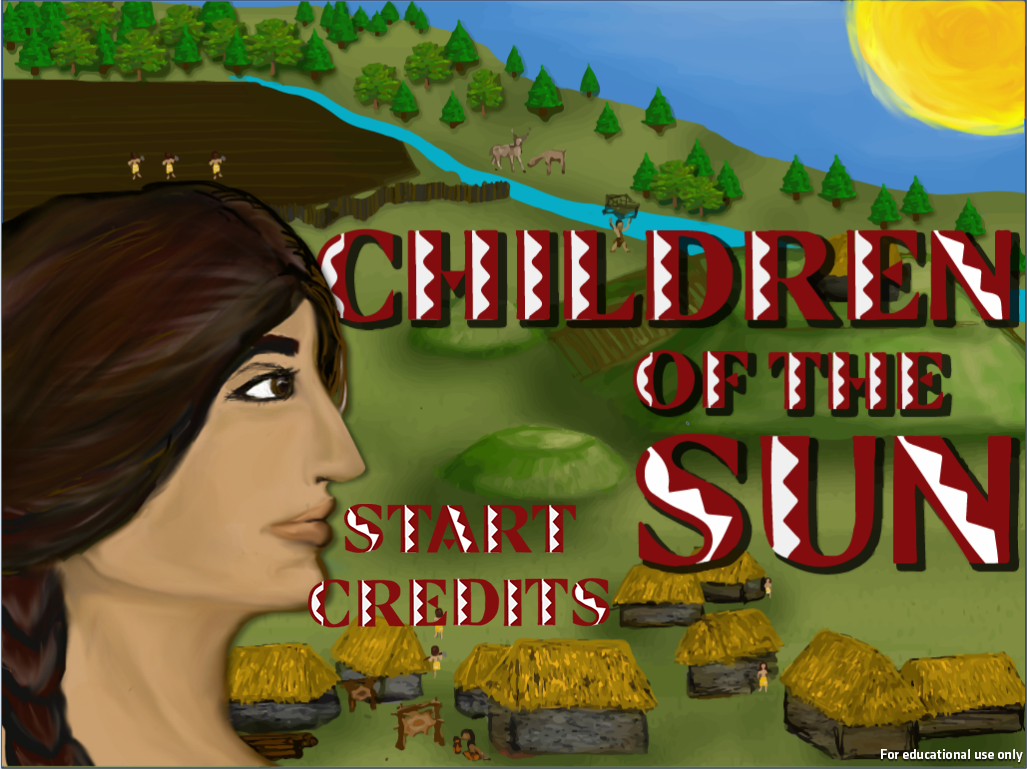
The Spring Game Studio—having officially been named Purple Maize Productions—had two formal meetings during finals week. On Monday, the team delivered Children of the Sun, their educational video game based on the Middle Mississippians, to our community partners at the Indiana State Museum. This was to mark the end of the team's production focus, and on Friday, we held our last formal meeting: a semester retrospective focused on what the team learned during their fifteen weeks together.
The team was able to overcome significant human, technical, and design barriers in order to create this game. On the human side, the team was working in a shared space but without a shared time. I had to decide during recruitment whether my priority was to pick the best student composition or those who could work at the best times. I chose the former, and so my individually-talented students had to work around the lack of consistent, whole-team synchronous communication. We used Google Groups and Google Drive for digital communication and, in physical space, several shared whiteboards. On the technical side, we were developing a networked iPad game without being able to have a persistent server: we ended up using Bonjour to discover local machines,  with one having as both server and client. None of the students had network game development experience, and most had no game development experience at all—much less educational game development. Finally, regarding design, the team was working within a rare combination of constraints: an educational game, about Middle Mississippian culture, for upper-elementary school students, that they would play only once, on iPads, together, in a formal educational program about archaeology.

Start screen
In the village, giving orders to 300 villagers.
The layout is based on archaeological evidence from Angel Mounds.

Planning, Reviews, and Retrospectives

In the past, I have always aligned the three Scrum-style meetings of Planning, Review, and Retrospective to align with weekdays: Planning on a Monday, Review and Retrospective two Friday's later, for a two week sprint. Unfortunately, the only time the Spring Studio reliably had to meet as a whole was Tuesday mornings, so modifications were in order. We held Planning meetings at the beginning of a two week sprint, and at the end, we held short Review meetings with whoever could be available on the Monday afternoon ending the sprint. The Retrospectives were not aligned with the end of sprints, instead taking place on Tuesdays that were not planning meetings. We did not have a retrospective in the middle of the first sprint, and another was cancelled due to my planning error; hence, we had only three iteration retrospectives during the semester.

I articulated and prioritized user stories based on my understanding of the team, the project, and the community partner. The Sprint Planning meetings went in two phases: planning poker to assign story points, then the team's breaking down the stories into tasks. I often skip planning poker in a three credit-hour studio course, but since these students were earning six, we had time to include it. I'm glad we did, since the conversations that arose from this activity helped the team to see what needed to be done; this was especially true later in the semester as the team developed a better vocabulary and better understanding of the game, the tools, and our processes.

Promotional art for Children of the Sun Infinite.
I have been in the habit of using a Start-Stop-Continue format for iteration retrospectives, and it has served my teams well. However, I read Kua's The Retrospective Handbook: A Guide for Agile Teams in preparation for the semester, and I decided to deploy some ideas from it. For this semester's iteration retrospectives, I wrote four categories on the board:
  • What did we do well?
  • What did we learn?
  • What should we do differently?
  • What still puzzles us?
At the beginning of each retrospective, I read the prime directive and then asked the team to write down contributions on sticky notes for each of these categories while I did the same. After ten or fifteen minutes, we came to the board and posted them all, and I encouraged the team to read each others' to find clusters. Then, I led the team in a left-to-right reading and discussion of the notes, looking in particular for potential action items, which were recorded on a separate board. After going through all of the items, we culled the list of potential action items into just those items that the team agreed were important. Individuals committed to these, and the meeting was adjourned with another reading of the prime directive.
We were rarely all in the same place at the same time, but this artist's rendering shows what it might have looked like.
One thing I missed in the early retrospectives—honestly, because I forgot—was to triage troublesome notes into a separate column. There were a few cases where we probably had too deep a discussion about singular notes, and this broke our stride: we should have postponed that discussion, since the rest of the exercise was going to reveal more details about it anyway.

There's a good story here about community learning. In the early sprint planning meetings, I served my usual role of directing both the planning poker and task articulation processes. However, it was revealed in a retrospective meeting that my articulation of a particular UX design process did not make sense to the team. (Their reasons for not seeking clarification during the planning meeting or when the miscommunication was recognized are not known to me.) One of the action items from that retrospective meeting was that one team member was responsible for ensuring that when I wrote a task, the team understood what it meant. However, the more I thought about this, I realized that a better approach would be to give the articulation more directly to the students. Surely, I had modeled the expected behavior well enough for them to do no worse than I did! At the next planning meeting, after planning poker, I told them it was up to them to take charge, and I sat down. To my great delight, two of them jumped up, ready to grab the sharpie and sticky notes. They did a great job, and I don't think the team had any more of these task-articulation defects.

Sprint Planning: Student-Directed Task Articulation

The End of Production

Our original production schedule called for the game to be feature-complete four weeks before the end of the semester, allowing ample time for polish, quality assurance, evaluation of efficacy, and consideration for distribution on the App Store. The team missed this goal, as well as the revised goal of being feature-complete two weeks before the end of the semester. I set a firm production deadline of 4PM the Friday before our final meeting, which the team also missed. Work continued through the weekend, though by only one or two developers who claimed it was all clean-up. This "clean-up" required additional clean-up Monday morning before the ISM meeting. The ostensibly final version that was delivered at the meeting was revealed, in the demonstration, to have a defect that prevented the game from starting. The team was duly embarrassed and, to my embarrassment, pulled out a laptop and tried to fix the game during the meeting. As another part of the meeting continued, a small group was able to put in a kludge to get the demo working, at least partially.

One of the team members agreed to drive down to the ISM on Thursday to deliver the fixed version of the code. I became concerned about the radio silence after Monday's meeting, and on Wednesday, I posted a message to the team stating, "I trust that the changes made between Saturday and Monday have been subjected to rigorous quality assurance." This was a manipulative lie, of course. One developer (or perhaps I should say, only one developer) came in and spent several hours in the studio Wednesday, where he rooted out the actual defects and fixed them—despite his being nearly overwhelmed by his senior capstone project, which was due at the same time. I have to wonder, what would have happened if he had not done this?

Final presentation to the ISM. Notice the nifty team polo shirts!

Semester Retrospective

In the past, I have used a two-phase, divergent-then-convergent approach to semester retrospectives: the team brainstorms a list of things they learned during the semester, and then votes on the top collectively-important items. Recently, however, I read "Groupthink: The Brainstorming Myth," which reminded me of the dangers of purely-divergent, criticism-free brainstorming. I decided to ask the students, several days before our final meeting, to reflect personally on what they learned. In particular, I asked them to produce an artifact such as an essay or list based on this reflection, arguing that articulating their ideas would help their understanding—a classic encouragement of writing for metacognition. In hindsight, I should have asked them to send a copy to me: one student did, of his own volition, and looking at it now, I can trace his personal learning into the collective learning.

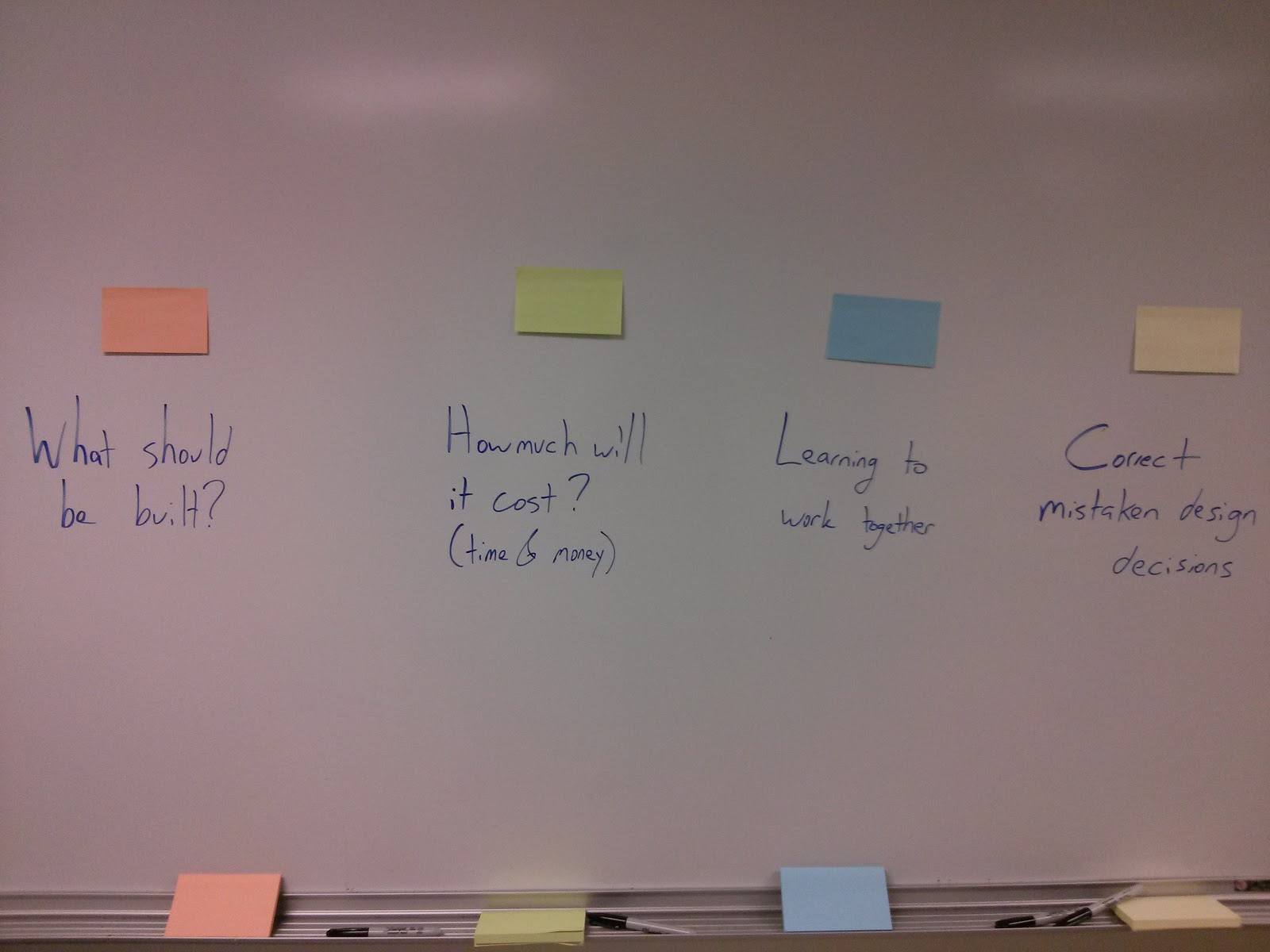
For the retrospective meeting itself, I was strongly inspired by Alistair Cockburn's recent technical report on knowledge acquisition during product development. In this report, Cockburn identifies four areas in which teams build knowledge, quoting:
  1. How to work together, and indeed, whether these people can get this job done at all.
  2. Where their technical ideas are flawed.
  3. How much it will cost to develop.
  4. Whether they are even building the right thing.
I paraphrased these four categories on one whiteboard and gave each a stack of colored sticky notes. Comparing my shorthand to Cockburn's articulations, I realize I should have used his nomenclature: it is more elegant though more verbose, but I had the room:
Four categories of knowledge acquisition.
I drew a timeline across the adjacent whiteboard, highlighting significant events from the semester, including: the three week orientation and design workshop; the six subsequent two-week sprints; our presentation at the Building Better Communities Showcase, the Butler Undergraduate Research Conference, the Ball State University Student Symposium, and Science Day at the Fairgrounds; and our meetings with the ISM. The team reviewed the timeline and agreed that I had all the major events in the right places.

After explaining the four categories, I invited the team members to translate their individual learning (from their personal reflections) into collective learning, to choose a category and write down something the team learned, and to mark it on the timeline. They seemed a bit hesitant, and when I asked if they wanted me to start, they agreed. I picked up a blue sticky note and wrote, "Dr. G cannot be here in the studio all the time," explaining that I learned that I could not be there with the team as often as I wanted to. Although I knew this, cognitively, from the start of the semester, its implications didn't really hit me until about a third of the way through production. They agreed that this was a good estimate of when the team recognized that my interventions would be necessarily periodic, and so I stuck the note there and sat down. (In hindsight, I should have written one of the implications of this, namely, that I wouldn't know what people were working on.) They still seemed hesitant, so I stood back up and grabbed an orange note, marking on it that it we were making a game about the Middle Mississippians; I actually knew this before the semester started, but it was announced to the team at the end of the first week of the semester, so that's where it went.

After this, team members began coming forward and adding to the timeline. However, to my dismay, one of the first people to approach the board, grabbed a pad, and then sat down in a chair by the board. I held out hope that they would write quickly and get back up, but sadly, this became the pattern: people grabbed the pad they wanted, sat down to write, and then put the note on the board. In fact, after a time, people just wheeled their chairs forward and grabbed a pad. I suspect that this was a significant loss of momentum, and I regret not having moved that chair away. Several times, it was clear the student didn't really know what to write until he or she had grabbed a pad and sat down and started to talk through it. Despite this, I am glad with what the students contributed, although I had hoped for more items.

Annotated timeline from the semester retrospective
The image above demonstrates that a majority of articulated learning outcomes dealt with how the team should work together (blue). While there is a good spread throughout the semester, there is a cluster in the rightmost side, which is marked in the timeline as "today." These are items that came out of the personal reflections and collective retrospective, and they include the idea that the studio space is important, that technical debt needs to be paid off regularly, that we had a particular focus on "making" (in contrast to, say, "understanding") in part because it's what the team was explicitly recruited to do, and that it's easy to fall into the human failure mode of inventing rather than researching.

Here are a few of my personal highlights from the timeline. Clustered at the middle and end of the penultimate sprint are "Test Early and Often," "Playtests Reveal Defects," "SRP," and "The importance of Clean Code Principles." This is really where the team came together and recognized the value of what I had been preaching from the beginning: it is important to have an iterative design process that incorporated real end users, and having a solid technical foundation is necessary for being able to adapt to these changes. Unfortunately, by this point, the team was locked into their game design and software design, so there were not many significant design changes even where it would have been beneficial. However, it's important here to remember that ours are academic risks, and the fact the team learned these ideas before the end of the semester is a great win for studio-based immersive learning.

The team had a booth at Science Day at the Fairgrounds
I was disappointed that the team misconstrued the cutting of features as a team failure. Early in the semester, as I described in an earlier post, the team defined an ambitious set of features for the game. Of course, many of these were not included in the final game; more specifically, the features that were included were those with the highest priority based on our shared understanding of technical feasibility, the potential players, and the community partners. However, during the retrospective, the team described this outcome as a failure, as if cutting these features was bad or a sign of failure. It is good that the students recognized that some of these features revealed important cultural aspects of the Middle Mississippians, and that cutting these meant a lost opportunity; however, I think they failed to understand that this was normal in game development. All those features we described at the beginning of the semester were risks—unknowns. We never knew if they would actually teach what we wanted them to teach. By having a smaller, tighter game, I would argue that we have a better game. However, for the retrospective, I was more interested in seeing what they learned than in using the moment to teach any more about game development processes, so I left it alone.

Four team members at the 2013 Ball State University Student Symposium
I particularly wanted to push the students to consider the nature of commitment in a team where sprints were not completed and there was very little accountability for following the methodology. (As examples, the team "committed" to holding code reviews, but none were held; the team "committed" to Clean Code, but a majority of the code is in violation of these standards.) When I brought this up, I was surprised at the dissension. Some of them clearly understood my question: that the team had made commitments to each other and to me, and had not fulfilled them, and that this pattern became status quo—so what was learned? Others, however, argued that there was no problem, because the team was composed of amateurs, did not know how to estimate, and set their own goals: that is, in my nomenclature, they argued that these were not commitments at all despite being called them. I have as much trouble accepting this now as I did when it came up, in part because when I told them they were committing to user stories, I meant "committing" in the strict sense, not in a relativist sense. It became clear that this was something of a religious issue for some team members, and the best I could do end this debate was to suggest that the team learned, that day, that they still didn't agree on what the word "commitment" meant. They accepted this, but when I reviewed the board later, I was upset at how one of the students had articulated the outcome: the card reads, "Commitment is a fuzzy word." I suggest that it is not, and rather that the students have a fuzzy understanding of commitment, since they have so little experience with it. This raises a puzzling question for mentoring future projects: how will I identify and deal with future team members who don't share my definition? 

Post-Retrospective

After this group exercise, I asked the students to write personal essays based in response to a prompt: if they were put in charge of a similarly-skilled team to make an educational game for the ISM, how would they do it? I was surprised that most of the essays assumed that the team would be undergraduates working for credit during a semester, when this was neither in the prompt nor my intention. The essays revealed a consensus that iterative development should be beneficial, and that getting digital prototypes into the hands of players and sponsors earlier is better.

Testing on the iPads
Several pushed for a longer production schedule, at least two semesters, so there would be more time to incorporate feedback from playtesting and the community partner, as well as to recover from design mistakes. It is notable that several of the students had been involved in two-semester Computer Science senior capstone projects, so they were not just guessing that more time would help—they had seen it for themselves. The Spring Studio had been designed as a six-credit experience, which I tried in part so that they would have time to revise their designs. However, after these fifteen weeks together, I think the students are right: the issue may have less to do with hours-per-day and more to do with calendar time. It reminds me of my frustrations with teaching five-week summer courses in programming: one may have the same number of contact hours as a fifteen-week semester, but there's just not enough calendar days to develop a sense of the craft.

One of the students pointed out that the team had agreed to use pair programming, at my encouragement, even though they had little experience with it and some didn't believe in it. Despite this consensus, most of them did not actually practice pair programming for the first several weeks. After significant frustration with the project, some began pair programming—lo and behold, they saw that they were more productive in pairs than individually! He asked me, then, how can a leader get the team to see the benefits of pair programming earlier, or is it the case that a team must fail first? I laughed and pointed out that I have been dealing with that exact problem for several years! It was good to see that several of the students' responses mentioned pair programming a particular practice that they would adopt in a follow-up project, which suggests to me that they collectively felt its value.

The poster shows the evolution of a UX design from sticky notes to digital prototype.
The laptop shows the final version.
The team members were novices in almost all areas of serious game design and development, and they had struggled considerably with two related concepts: prototyping and iterative development. As a whole, though they recognized that physical prototyping was faster and cheaper than digital development, the team had trouble seeing the connection between physical prototypes and digital prototypes. When they finally did produce a digital prototype, there was some confusion about how to effectively evaluate and how to integrate playtesting results into development. This was undoubtedly related to the team's troubles with iterative development, which has been challenging for every student team I have mentored. Student experiences generally come from trivial individual projects or very small scale team projects—projects with no clients besides the students and a professor. This particular team did not successfully complete any sprint: there were no sprints in which all the user stories were completed and a potentially shippable product was created. Notably, the team rejected sprint renegotiation, preferring an optimism that resulted in sprint failure. This is unique in my student teams, as I recall. However, I also stopped recommending renegotiation after they rejected it in early sprints, and I wonder if I should have come back to it again.

Testing an early paper prototype

By university regulation, I must assign grades to the students, and so I try to do so in the most fair and unobtrusive way that I can. Each student had a midsemester progress report meeting with me, during which I tried to give useful, private, individualized feedback. At the end of the project, I gave the whole team a grade based on their collective achievement, although individual grades varied based on peer commendations. Such grading is rather stressful for me, and it is also divorced from the day-to-day activity that I want to encourage. Yet, I tend to be conservative in my interventions as Grade-Giver, preferring to offer mentor's advice that the team can choose to follow or not. Indeed, the team chose not to follow my advice to either complete all the user stories or renegotiate, and this did not doom the project: the game is still acceptable to the client, despite their collective dismissal of my suggestions. I talked informally with one of the team members who happened to also be in my Fall game design colloquium—my first experiment in badge-based grading—about whether a badge-based approach would work here. What if there was a badge such as "Completed all stories in a sprint" or even "Renegotiated a failing sprint"? He agreed that it would have to be very carefully designed. The best outcome would be that the student see more clearly what kinds of behaviors I value and promote, in such a manner as might lead to a performance bonus in industry; the worst outcome would be that students lose autotelic focus on the project and start to game the system for points instead of project success.

Looking Forward

I am proud of the work of Purple Maize Productions. They overcame significant obstacles to produce an original educational game, using tools, technologies, and processes that were new to all of them. They emerged from the semester with powerful, significant reflections—evidence that the learning outcomes of the studio were met. This was the also first time that one of my student teams attempted a multiplayer game. Should future teams do the same, I have some great stories to share with them, and I will know to push the team much earlier and more forcefully toward an end-to-end prototype. Indeed, given the complexities of testing and the tight fifteen-week time limit, I may simply advise students against any networked multiplayer, sticking with hot-seat or single-player games.

To experiment with potential villager animations, the team projected the village view onto the board and traced it. Brilliant!
I intend to reuse both of the retrospective formats from the Spring Studio experience. I like how the iteration retrospectives are oriented toward concrete action items and will likely keep the format as-is. I am considering two changes to the semester retrospective format. First, I would have the students submit their personal reflections to me before the meeting. This would serve two purposes: it would demonstrate their importance to the students, since I asked to see them, and I would have more data with which to triangulate actual team learning. The other change is that, after modeling how to write a team learning statement, I would give the students a few minutes to write out their own before posting them. This should avoid the problem of individuals coming to the board without really knowing what to say, since it would already be written.

There are still some puzzles regarding Purple Maize Productions. For example, why was the team hesitant to seek my advice in my areas of expertise, or from Ronald Morris, my collaborator on this project? Why was the team not fulfilling its commitments to each other regarding retrospective action items? Why did they continue to underestimate tasks sprint after sprint? Fortunately, this studio was also used to conduct research on immersive learning, and one of my colleagues from the English department collected field notes and two interviews from the students. I look forward to digging into this data with him and seeing what stories they tell.

In reviewing the semester, including the students' final essays, I find myself wishing I could have been more proactive in helping team formation earlier in the semester. With several past teams, I have hosted game nights and pizza parties, which help people get to know each other. At the start of the Spring—the critical time for breaking the ice—I had a newborn who was not sleeping through the night, an 8AM class that had me ready for bed when some of my students were just hitting stride, and a case of the flu that had me in my bed for almost a week. I hope that I never again have to deal with these factors along with a team that does not have adequate face-to-face meeting times!

I don't know what this is, but I love coming into the studio and finding things like this.
The ideal relationship between me and teams like this one merits further reflection. How do I balance the roles of professor, mentor, coach, designer, developer, and researcher? This semester, I opted to emphasize mentor, in part because I knew I could not work with all the students due to scheduling conflicts. Children of the Sun is a fine game, but it's very much the students' design. I can't help but look at the fascinating constraints my student team was given and be a little jealous: I wish I had fifteen weeks to work on such a project! Would it be better if I ran the team more like a research group, using student labor to realize my own designs? It would be different, and I would argue that it would no longer be "immersive learning," which enshrines student-direction and faculty-mentoring in its definition. This gets quickly into issues of community partner versus client as well as teaching versus consulting. There is a significant difference between what I can do and what I can mentor students to do, but I worry sometimes that the immersive learning model is presented as if these are the same. Immersive learning is not about providing free or cheap consulting services: it is about welcoming external partners to become co-teachers and co-learners with us.

Writing this post helped me recognize a critical difference between this project and Morgan's Raid, another course where I had separate design and production courses. In Morgan's Raid, the initial prototyping was done in the Spring, and I was able to refine these over the Summer. This also led to my selection of an appropriate software architecture, choice of a stable and appropriate toolchain, and design of interventions to help students learn these. I was able to start Fall's production course by saying, "Here's what we're building, and here's how we will do it!" By contrast, the Spring Studio inherited an unrefined (indeed, unplayable) prototype from Fall's design colloquium, and they had to create the game design, choose the toolchain, and design the software architecture. I provided recommendations of course, but I delegated the decision-making authority and process to them. I do not doubt that the Spring Studio learned much more about these items than the Morgan's Raid team, but I am unconvinced that it was worth the time and attention. Given that it is logistically impossible for me to recruit a two-semester team at this point, I will take a more hands-on approach regarding the transition between the design course and production studio next time.

Speaking of which, I am pleased to report that I have received internal funding through the Provost's Immersive Learning Initiative to teach another series on serious game design and development next academic year. I will be teaching a game design colloquium in the Honors College in the Fall and leading another six-credit multidisciplinary development studio in Spring. We will be working with my friends at the Children's Museum of Indianapolis to develop an educational video game. This upcoming collaboration is one of the reasons it was worth more than a day's effort to write this post: I want to ensure that I emerge from this past academic year with a good understanding of what went well and what went poorly so that next year, we can be even more successful.

Almost everyone was there for the team photo. This is a photo of that photo.

Acknowledgements

I would be remiss if I did not acknowledge some of the people, offices, and agencies who made this project possible. Thanks go out to: Ronald Morris, who was co-mentor of the project; Ball State University's Computer Science Department, History Department, Honors College, Building Better Communities office, Provost's Immersive Learning Initiative, and Digital Corps; Motivate Our Minds; College Mentors; the Indiana State Museum; and Angel Mounds.