Showing posts with label drinks. Show all posts

Tuesday, July 23, 2024

Mulberry Mead

It's time again for What is Paul Drinking? Today's notes are from my latest batch of mulberry mead, which I mentioned in my notes about making lattes. I think this is my second batch, with my first having been made in 2022. I found a bottle of 2022 in my cabinet, and if I've made other batches, they are lost to time. 

I put about a quart of mulberries into a saucepan with enough water to cover them. I cooked them a while to soften them, then gently muddled the berries, turning the water into beautiful purple. What I should have done (and what my wife recommended I do) is get as much juice out of the berries as possible then just use that in primary. Instead, I had the idea that I wanted the whole berries in the fermentation. I put all the solids into a mesh bag and dropped it into my usual mix of three pounds of honey and D47 yeast.

Unfortunately, the bubbling action of the fermentation lifted the bag right up and out of the water. In retrospect, that is predictable. I would have needed to use some weights to keep the bag submerged. However, I only wanted to keep the fruit in the fermenter a few days, and if I submerged it, it would have to stay until racking. In short, I had made a problem for myself.

Next time, just smash the juice out the berries and use that. 

In any case, the result is a lovely color. It has a subtle berry flavor, which I understand to come from the fact that the fruit was added in primary. It's quite different from when I infuse a mead with fruit, which picks up the fruit flavor more intensely. It also came out quite dry. Sometimes that is what I want, and sometimes I add just a splash of simple syrup to the glass before drinking. That's much simpler than formal backsweetening with no danger of exploding bottles from restarted fermentation.


Monday, June 3, 2024

Something like a latte

It's time for that recurring feature, "What is Paul drinking?"

The warm summer weather turned my mind toward coffee concentrate. I use a simple approach gleaned from online advice: fill a pitcher 24-35% with ground coffee, top it off with water, and let it sit on the counter for eight hours or so to brew, shaking occasionally. This gives a strong, dark liquid that is a great base for iced coffee, and I often have both decaf and regular in my fridge in season. It also works for a hot morning cup in cases where I am out of whole beans, which happened to be the case last week. 

The last week has been quite mild, the high temperatures only being in the low 70s. It wasn't the right weather for iced coffee, so I wondered what else I could do with my concentrate. I came across a site describing how to make a latte at home with no fancy equipment, and this inspired me to try something like that myself. Turns out, I can make something at home that is a lot like the cappucino I might order at the Bookmark Cafe.

Here's what I've been tinkering with:

  • About two ounces of coffee concentrate in a coffee cup, heated in the microwave for thirty seconds
  • Just under six ounces of whole milk in a ball jar, heated in the microwave for a minute
  • Froth up the milk using the fancy battery-powered handheld frother that, until recently, I didn't know we had in our kitchen utility drawer
  • Slowly pour the milk into the coffee cup, which will leave the foam on top.
The result is quite nice. It's not that much complicated than my usual French press coffee. It is pretty, and if your pants are really fancy, you can sprinkle cinnamon on top. The flavor and mouthfeel are pleasant, and I don't think I could tell you if it was made with espresso or coffee concentrate. I call this a successful experiment, and there's a good chance I'll be making a decaf one this afternoon. 

I normally don't sweeten my cappucino, but I wanted to try that last time I made one of these homemade lattes. I added some simple syrup and vanilla extract after combining everything, but I think if I did this again, I'd add it before frothing to eliminate stirring later.

I'm also working on a batch of mulberry mead, and I will have more to say about that later. In particular, I will probably say, "Don't put the bag of berries into the carboy because it will float to the top and cause headaches." 

Saturday, February 25, 2023

Amari 4 and 5

I enjoy continuing to make amari. I wrote about my three in a series of posts (1, 2, 3), and now I'll share a few notes about numbers 4 and 5.

For my fourth amaro, I used the 20-50-30 AWS ratio that I learned about for number 3. For the ingredients, I pulled together some things that I thought would make for a nice, light, citrusy amaro. This would be a good foil to the intense #3. Here's what I used:

  • 2 tsp. juniper berries
  • 1/2 tsp. anise seeds
  • 1/2 of a stubby long pepper
  • 1/2 tsp. decorticated cardamom 
  • pinch dried sage
  • 1 tsp. dried orange peel
  • 1 clove
  • 2 allspice berries
  • 1/2 tsp. coriander seeds
  • 1 tsp. gentian root
  • 1/2 tsp. cacao shells
  • 1 tsp. dried peppermint
  • 1 pinch dried rosemary
  • 1 tsp. dried lemongrass
I set these for a week in a 50% alcohol-water solution and then filtered and bottled it. It has a very nice citrus flavor and, like its predecessor, is not too sweet. This concoction really sold me on that 20-50-30 AWS ratio. This amaro is good as a digestif, but my favorite thing to do is to use it in an old fashioned cocktail: 1-1/2 oz bourbon, 1/2 oz amaro, a touch of orange syrup, served on the rocks. I dubbed this batch "Amaronge you glad I didn't say 'banana'?"

Incidentally, that orange syrup was the result of an attempt to make an elevated syrup. I packed orange peels in sugar to extract the flavorful oils like in a video a friend sent me. I think the video exaggerated the effect, but my results were still good. After letting the peels macerate with the sugar for a day or two, I ended up just rinsing the container with some water and then heating it until it became an excellent orange syrup. The peels would have gone in the compost anyway, so this was a worthwhile.

Speaking of saving things from the compost, let's talk about my fifth batch. I bought myself a bunch of new amaro ingredients for my birthday. When they arrived earlier this month, I now had what I needed to replicate the Open Source Liqueurs Base Amaro recipe. My first step was to save some grapefruit rinds from ending up in the compost and remove the zest from the pith. The recipe calls for three grams of grapefruit peel... but is that fresh or dried? All the zest I could salvage still did not register as a gram on my kitchen scale. I had no fresh oranges, and so for reference, I measured three grams of dried bitter orange peel:

How is one to compare amount by volume of fresh zest and dried peel? It's not at all clear to me, but these two look approximately the same. I marked in my notes that three grams of bitter orange peel was about 1-1/2 teaspoons. 

The Open Source Liqueurs recipes are by weight, which is a good and proper way for fancy people to cook, but my scale is clearly not up to the task. Hence, I measured where I could, substituted where necessary, and winged it as inspired. Mine ended up like this:

  • Some fresh grapefruit zest
  • 3g bitter orange peel
  • 10g Turkish rhubarb root
  • 6g gentian
  • 1 tsp hyssop (which still didn't measure as a gram on my scale so maybe that's close to 0.5 g?)
  • 1 tsp dried peppermint (no spearmint available)
  • a little broken stick of cinnamon (weighing under one gram)
  • 1 tsp whole dry rosemary (again, under one gram)
  • about a teaspoon of myrrh granules
  • 1/2 tsp. decorticated cardamom
  • 1 clove
  • a generous pinch of dried sage
Here's how it looked once everything was mixed together.

That's a nice light amber color. After a week, it was much more intense:

The lighting here makes the maceration jar look dark brown, but there was also a slight purple hue when held to the light. It was really beautiful, and that got me excited when I gave the jar its periodic swirl.

Here's how it looks in the glass after sweetening with demerara sugar syrup, which also brought it to the proper AWS ratio.


It's good, but it is very grapefruit-forward. If you feel like grapefruit, this is your thing, but if not, then it's not quite right. I've tried it in some cocktails, but grapefruit and orange are just not the same. I'd like to try a riff on this recipe some time later with either less grapefruit, less grapefruit maceration time, or increased fresh orange zest, or some combination of those.

Because this one is really a spin on the Open Source Liqueur's recipe, I've named batch #5 as "OSL v1.0."


Tuesday, January 10, 2023

Amaro #3: Parslamaronious

I love parsley. We had some fresh, flat Italian parsley in the house despite the cold weather since my wife needed it for some Christmas dishes. This got me thinking, "What would that taste like in an amaro?" My wife was skeptical, but I was inspired.

Let me introduce you to Amaro #3: Parslamaronious.


Yes, where the first two took the slightly uninspired names Amaro Primo and Amaro Secondo, I've decided to break the pattern here because I just love how very silly this name is. I made a lot less of this batch than of the other two, starting with just ten ounces of 90% ABV GNS. Yes, I'm using hobby jargon. These are exciting times. Into the spirit, I put the following in the hopes that it would complement the parsley:

  • 1/2 tsp coriander
  • 1/4 tsp decorticated cardamom
  • 1/2 tsp anise seeds
  • 1/4 tsp fennel seeds
  • 2 tsp juniper
  • 1 sprig rosemary
  • 1 sprig flat Italian parsley
  • 2 tsp gentian root
The rosemary was from our garden, but it was not the healthiest sprig. I used a generous amount of gentian root, a proportion more like the one at Open Source Liqueurs than the Serious Eats recipe that inspired the first amaro I made. You might wonder why I used so much juniper. The reason is that we have a lot of it. We got a deal on dried juniper berries years ago and use them occasionally for making flavored sodas inspired by DRY Juniper soda (which doesn't seem to be available any longer). 

Still no mortar and pestle here, so I smashed everything except the parsley and rosemary sprigs with my muddler. It seems like that should be adequate. I macerated for 12 days, leaving the jar in the buffet and giving it a swirl about once a day. I was going to leave it for two weeks, but reflecting Sammie Williams' recipe at Open Source Liqueurs made me process it a little earlier than planned. Also, it was Scout night, so I had the kitchen to myself. The recipe I used for my first amaro, and which I improvised on for my second, diluted the spirit with simple syrup. Williams' recipe uses a 3:5:2 ratio of alcohol, water, and sugar. (AWS, jargonites.) He also recommends against making a syrup and for using turbinado or other solid sugars in his "Making Amaro" article.

I strained out the solids and then split my alcohol in two. With the first half, I measured out the 3:5:2 quantities, using entirely turbinado sugar, and put them in the blender. We have a nice blender, and 30 seconds of whizzing had it all mixed and bubbly. I actually got a little worried here when I opened it because it also got pretty warm. The color was unfortunately rather unappetizing: whereas the infused alcohol was chartreuse green, the mix was slightly brown yellow... not enough to be a nice caramel brown, just a kind of dirty green. With the other half, I mixed up a syrup using the same water-to-sugar proportion. This had only about half turbinado sugar and half granulated sugar since I had used up all the turbinado in the house. Dissolving the sugar, letting it cool, and then mixing in the alcohol all went smoothly, as in the past. I felt more control over this than I did the blender, to be honest, and I couldn't tell any difference between the two batches except that the second one was slightly less brown. It must have been the sugar.

How does it taste? Well, right off the bat, yes, you get parsley. Neat! Also, a little weird. But it's not bad weird. Not like the time I infused oregano and some other herbs into some mead and it tasted like liquid oregano. That ended up going down the drain. This amaro is actually quite nice, as long as you're looking for something herb-forward. A funny thing is that although the parsleyness is detectable at first, it becomes less so with a few sips. I wonder how it will taste after aging a bit. Since it was a small batch, I wonder if it will last long enough to find out. 

I should also mention that I really like this AWS ratio. My previous two amari are very sweet and syrupy. It's not a bad mouthfeel, but it's not real classy either. In case anyone is really curious about the math, I did counted my 90% ABV GNS as being essentially 100% alcohol when doing the algebra, which means my final ratio is not exactly 3:5:2. Considering that I'm not using a milligram scale nor even filtering out the tiny bits that end up the bottle, I'm not worried about a little variation from the formula.

Coming back to the Open Source Liqueurs recipe one last time, I really appreciate Williams' site, and I want to try his base amaro. In terms of approach, I am curious about his maceration in 50% ABV, since I've been macerating directly in everclear. My birthday is coming up, so I splurged and ordered odds and ends from Mountain Rose Herbs to try making something akin to his recipe. Ordering myrrh on Epiphany also seemed appropriate. I look forward to making my own #4 once I have everything together.

If you got this far through my contemplations and reflections about homemade amaro, come over for a drink. Cheers!

Monday, November 21, 2022

Amaro Secondo

Following up on my last post, I processed my second batch of amaro last Friday. So far, I am using the clever name "Amaro Secondo" for it because I cannot think of anything else. Rather than following a formal recipe, I simply grabbed a bunch of things that I thought would be good together. I had some my help from my wife in finding and considering ingredients, and this is what I ended up using.

  • 2 tsp gentian root
  • 1 cardamom pod
  • 1 tsp dried orange peel
  • 8 dried juniper berries
  • 1 tsp lemongrass
  • 1 pinch dried rosemary
  • 1/2 tsp fennel seed
  • 1 tsp coriander
  • 3 crushed roasted hazelnuts
I kept roughly the same volume of ingredients as in the first batch. I used a lot more gentian root after reading an article that suggested a much higher ratio of bittering agent to alcohol compared to the recipe I followed the first time. I did not include any fresh ingredients, in part because my friend who inspired me to try this had himself made two batches, one with fresh herbs and one with only dried. I also did not use the blender this time but instead beat up the ingredients by hand using a wooden muddler; this was not as effective as a mortar and pestle, but it did break up things like the cardamom pod and coriander seeds.

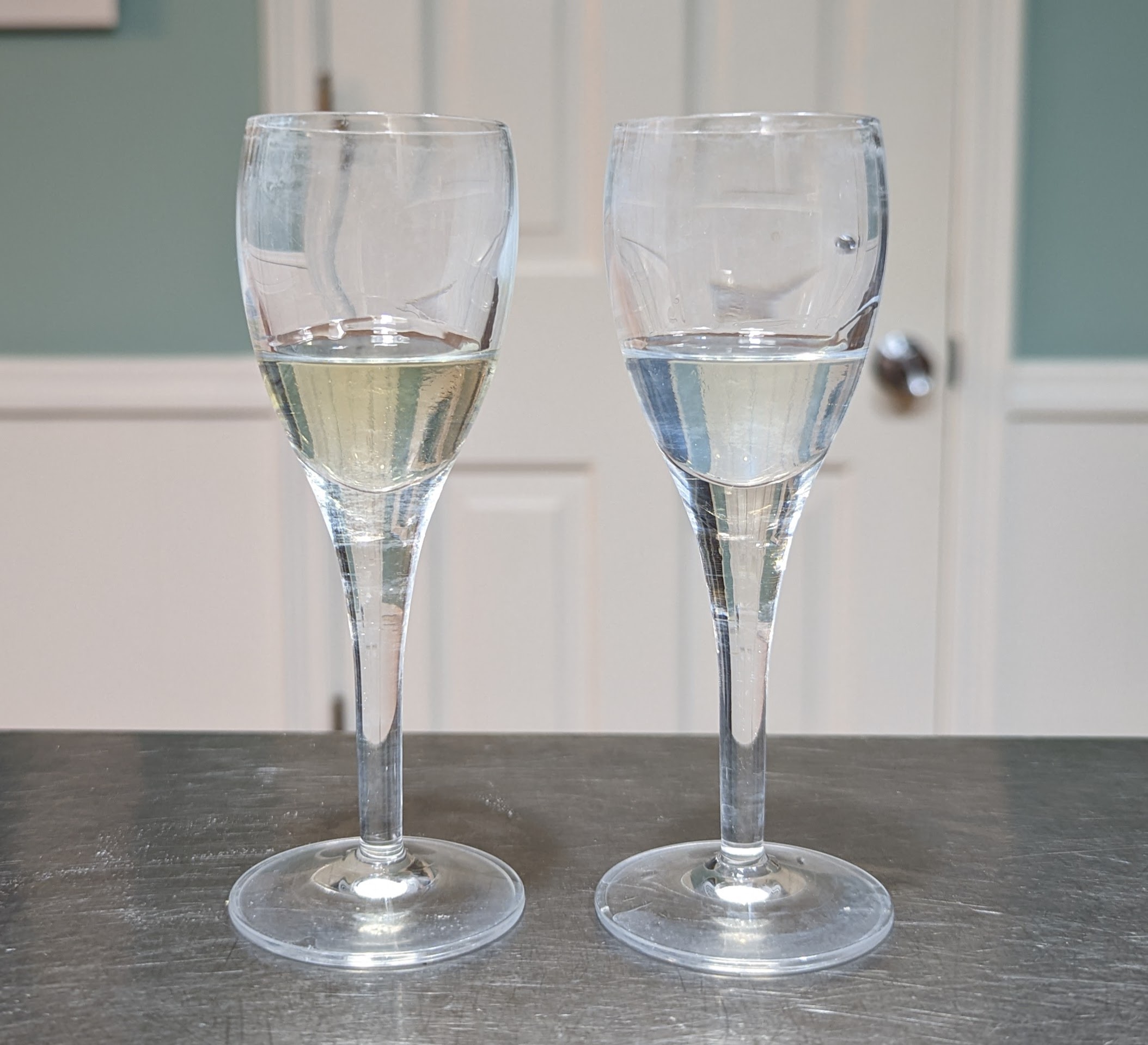
Whereas my first amaro was beautifully green during maceration, this one was a pale brown. However, after processing, I would have told you that they were about the same chartreuse color. Putting them next to each other, we can see that the first one is noticeably more colored than the second.

Two Amari (first batch on the left)

Tonight was the first time I tried them side by side. There's probably a right way to taste test amari, and my approach of just swishing some water between was almost certainly not it. The first batch has a more pleasant aroma than the second: hold it under your nose, and you pick up something between camphor and anise. The second one has almost no aroma at all. Sipping the first, it's again that camphor/anise that hits you first and strongest, with bitter undertones. The second one has a more bitter foundation that seems to change more in the aftertaste. I also pick up subtle notes of what I think is the coriander but may be the citrus peel, a sort of lemony flavor that is unlike the first.

I have a lot of amaro in my cupboard that I need to share before making more, but I do find myself thinking about what I would try next. If I were to go in this citrusy direction, I would include some fresh ingredients along with the dried ones, perhaps citrus peel. I also wonder about adding just plain more ingredients. Some recipes I find online use ratios about like what I have, while others encourage adding much more stuff.

Friday, November 11, 2022

Amaro Primo

Last night, I finished processing my first batch of homemade amaro. I used Marcia Simmons' recipe at Serious Eats to get started. Knowing how the Internet has consumed some of my favorite recipes over the years, I will share what I actually used, which was a slight difference from Simmons' recipe just due to what I had on hand.

  • a broken, incomplete piece of star anise (original recipe: 1 teaspoon anise seeds)
  • a few dried sage leaves (original recipe: 6 fresh leaves)
  • a few ragged but technically fresh mint leaves (original recipe: 6 fresh leaves)
  • 1 sprig fresh rosemary
  • 1 allspice berry
  • a few whole cloves (two or three, I don't remember)
  • 1/2 tsp gentian root
  • 3 cups 190 proof Everclear / grain alcohol
I was able to get the Everclear at Muncie Liquors on Jackson. I ordered the gentian root from Mountain Rose Herbs when the boys and I were also ordering some other esoteric spices for my wife's birthday a few weeks ago. We do not have a mortar and pestle, but we do have a spice grinder. Unfortunately, it is almost exclusively used for processing Szechuan peppercorns; I chose against using it since I did not want to make a numbing amaro. We ended up blitzing the spices in the blender to try to break them up. It did bust them up a bit, but there was so little volume that it had a hard time pulsing them.

I macerated the herbs and spices in the alcohol for three weeks as per the original recipe. Note, however, that the recipe called for 150-proof spirit, and my more recent reading leads me to suspect that I could have stopped the maceration earlier. I kept the mixture in a Ball jar on the counter near my tea and coffee area, which meant I would remember to give it a swirl each morning when making my morning drinks. The most significant change was over the first two days, when it changed from basically clear to beautifully green. About two weeks into the process, I did some more reading where it was recommended to keep the mixture in a dark place. Oops. The last week or so, then, the jar was kept in the liquor cabinet.

Emiko's post at Food52 explains that for 95% alcohol like mine, one typically wants a 2:1 ratio of simple syrup to infused alcohol in order to get to an appropriate ABV and sweetness. That post also mentions that you can get four cups of syrup by combining 3 cups of water with three cups of sugar. This is a helpful ratio to know since it's not otherwise obvious to me how the respective volumes of sugar and water combine to determine the volume of the syrup. A little simple algebra reveals that I needed 4.5 cups of sugar dissolved in 4.5 cups of water, giving me the six cups of syrup I would need to mix with my three cups of alcohol.

On my wife's recommendation, I used a fine metal tea strainer to filter the solids from the alcohol, and this worked great. There may be a few very fine flecks in the resulting liquid, but it was much easier than dealing with multiple passes through a cheesecloth or spice bag. Once the syrup had cooled off (although it was not yet room temperature, because it was late and I was feeling impatient), I mixed the two together and poured the result into a half-gallon Ball jar, with the overflow going back into the smaller jar in which I had done the maceration.

Earlier, during maceration, I occasionally took the lid off to smell the concoction. It basically smelled like alcohol: the fumes from the booze overpowered any sort of pleasant, herbal aroma that I had hoped for. This made me a little nervous. I was surprised then when, as I was straining the alcohol, I could almost pick up two different aromas: one was the intense alcohol but the other was a more mellow, pleasant scent.

Here's the result:

The recipes say to let the combined alcohol and syrup sit for two weeks or so for the flavors to continue to develop, but of course, I couldn't help myself from pouring a little glass for myself. I like it, but I find myself lacking some of the words to describe what it is like. It reminds me a little of absinthe⁠—although maybe that is in part the color⁠—mixed with something grassier. It might be the bitter gentian or the herbal sage that I am picking up on. My wife hasn't tried it yet, as she was early to bed last night. I am eager for her opinion since she has a better ability to name flavors than I do.

I actually have a second batch macerating in the liquor cabinet already. Originally, I was going to wait until this one was done, but then I decided to just go for it, to mix up a bunch of things that sound like they would go well together and see what happens. Watch this blog for a follow up in a few weeks.

My biggest question right now is what to call this. The title of this post is just a bit of fun with Italian, but I thought about perhaps naming them as a sequence. Popes? Letters of the alphabet a la Ubuntu releases? Let me know if you have an idea in the comments.